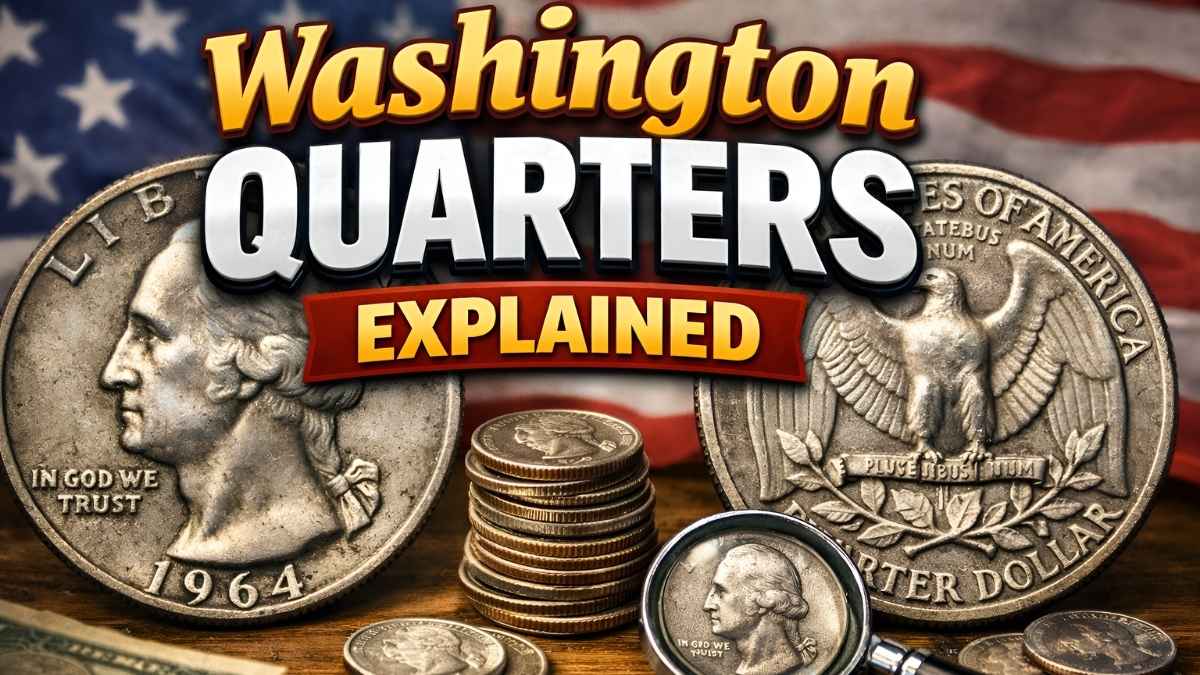
Washington Quarters Explained: The Washington Quarter was first introduced in 1932 to honor the 200th anniversary of George Washington’s birth. Originally intended as a one-year commemorative coin, it quickly became a permanent fixture in American currency. The design was created by sculptor John Flanagan, who depicted Washington’s profile on the obverse. The reverse featured a heraldic eagle perched on arrows with olive branches beneath, symbolizing both strength and peace.
This coin replaced the Standing Liberty Quarter, which had been in circulation since 1916. The Washington Quarter was embraced by the public and collectors alike, setting the stage for decades of design changes and historical significance.
Design Evolution Over the Decades
The Washington Quarter has undergone several design transformations since its debut.
- 1932 to 1964: The original design by John Flanagan remained largely unchanged. These coins were composed of 90 percent silver and 10 percent copper, giving them intrinsic value beyond their face denomination.
- 1965 to 1998: Due to rising silver prices, the composition shifted to copper-nickel clad. The obverse portrait of Washington was retained, but the reverse eagle design continued until 1998.
- 1999 to 2008: The 50 State Quarters Program brought a dramatic change. Each state was honored with a unique reverse design, making the series one of the most popular in U.S. coinage history.
- 2009 to 2021: The America the Beautiful Quarters Program followed, featuring national parks and historic sites.
- 2022 onward: A new era began with the American Women Quarters Program, highlighting influential women in U.S. history.
These changes reflect not only artistic evolution but also cultural shifts, as the quarter became a canvas for national identity and storytelling.

Mintage Numbers and Their Significance
Mintage numbers play a crucial role in determining rarity and value. Some Washington Quarters were produced in massive quantities, while others had limited runs.
- 1932: The first year of issue saw relatively low mintages. Philadelphia produced over 5.4 million coins, while Denver and San Francisco struck fewer than half a million each. These lower mintages make the 1932-D and 1932-S quarters highly sought after by collectors.
- 1940s to 1960s: Production soared, with tens of millions minted annually. These coins are common in circulation but can still hold value in higher grades.
- State Quarters Era: Mintages varied widely depending on demand. Some states had over 1 billion coins struck, while others had fewer, creating interesting dynamics for collectors.
Understanding mintage figures helps collectors identify which coins are scarce and which are more readily available.

Values of Washington Quarters
The value of a Washington Quarter depends on several factors: year, mint mark, condition, and whether it contains silver.
- Silver Quarters (1932–1964): These coins carry intrinsic value due to their silver content. Even in worn condition, they are worth more than face value. For example, a common silver quarter might fetch several dollars based on current silver prices.
- Key Dates: The 1932-D and 1932-S are considered key dates, with values ranging from hundreds to thousands of dollars depending on condition.
- Error Coins: Doubled dies, off-center strikes, and other minting errors can significantly increase value. The 1934 doubled die obverse is a famous example.
- Modern Quarters: While most copper-nickel clad quarters are worth face value, certain limited issues, proofs, and high-grade examples can command premiums.
Collectors often use grading scales to assess condition, ranging from Good (G) to Mint State (MS). Higher grades bring exponentially higher values.
Collecting Washington Quarters
Washington Quarters offer something for every collector, from beginners to seasoned numismatists.
- Affordable Entry: Common silver quarters and state quarters are inexpensive and easy to find.
- Challenging Pursuits: Completing a full set from 1932 to present is a rewarding challenge, especially when seeking rare mintages.
- Historical Connection: Each design tells a story, whether it is Washington’s legacy, a state’s heritage, or a national park’s beauty.
Collectors often enjoy the thrill of searching through circulation, coin shows, or online marketplaces to find missing pieces for their collections.
The Cultural Impact of the Washington Quarter
Beyond its monetary role, the Washington Quarter has become a cultural symbol. It reflects America’s evolving identity, from honoring its first president to celebrating states, parks, and influential women. The coin has been a teaching tool for history, geography, and civics, sparking interest in young collectors and educators alike.
Its widespread circulation ensures that nearly every American has held one, making it both a common object and a piece of living history.

Conclusion
The Washington Quarter is more than just a coin. It is a timeline of American history, art, and culture. From its silver beginnings in 1932 to the modern commemorative programs, it has remained a staple of U.S. currency and a favorite among collectors.